Scroll any social feed in 2026 and you will meet them: a puppy rescued from an impossible flood, a “lost” photo of a historical event that never happened, a celebrity promoting an investment they have never heard of, a politician saying something they never said. Some are harmless junk. Some are designed to fool you, take your money or damage someone's reputation.
The problem has grown so familiar that it has its own vocabulary. In 2025 Merriam-Webster chose “slop” as its word of the year, defining it as low-quality digital content produced, usually in quantity, by artificial intelligence. Australia's Macquarie Dictionary picked “AI slop” for the same honour. This guide explains what is out there and, more importantly, how to tell what is real.
A few terms worth knowing before we start:
- AI slop: low-quality content mass-produced with AI, usually for clicks, followers or ad money.
- Deepfake: a realistic fake image, video or audio clip that shows a real person saying or doing something they never did.
- Voice clone: an AI copy of someone's voice, often made from a short recording.
- Cheapfake: real media that has been simply edited, slowed down or given a false caption, no AI required.
What is AI slop?
AI slop is the digital equivalent of junk mail. Because generative AI can produce text, pictures, music and video in seconds, some accounts and websites publish it in huge volumes: fake animal rescues, “photos” of places that do not exist, recipe pages written by machines, low-effort e-books and video channels voiced by synthetic narrators. The aim is usually attention, because attention can be turned into advertising money, followers to sell, or an audience for a scam later.
Not all AI-made content is slop. Plenty of people use AI tools carefully and say so. What makes something slop is low effort, high volume and a habit of passing itself off as real or human-made.
What is a deepfake?
A deepfake uses AI to make a convincing fake of a real person: swapping a face in a video, animating a photo, or cloning a voice so it can say anything. The technology has legitimate uses in film, dubbing and accessibility, but it is also used for fraud, harassment, political misinformation and non-consensual intimate images.
What has changed is quality and cost. Realistic video with matching sound can now be generated from a short text description, and the FBI warns that criminals can clone a loved one's voice from short audio clips.
AI-enabled synthetic content is becoming increasingly difficult to detect and easier to make.
How scammers use fake voices and videos
In its 2025 Internet Crime Report, the FBI listed AI as a separate category for the first time. It received 22,364 complaints mentioning AI, with reported losses of more than $893 million. The real figure is likely higher, because many victims never realise AI was involved.
- Investment scams: fake videos of celebrities, business leaders or trusted figures endorsing “can't lose” schemes. Complaints with an AI link reported losses of more than $632 million in 2025.
- Family emergency scams: a cloned voice of a child or grandparent calls in distress asking for money. Victims reported losses of over $5 million to these “distress” scams in 2025.
- Business fraud: fake emails, voices or video calls that appear to come from a boss and ask for an urgent payment. Businesses reported over $30 million in losses to AI-linked business email compromise.
- Romance scams: fake profiles and AI-written messages that build trust over weeks before asking for money.
- Fake job candidates: deepfaked video interviews used to get hired and gain access to company systems.
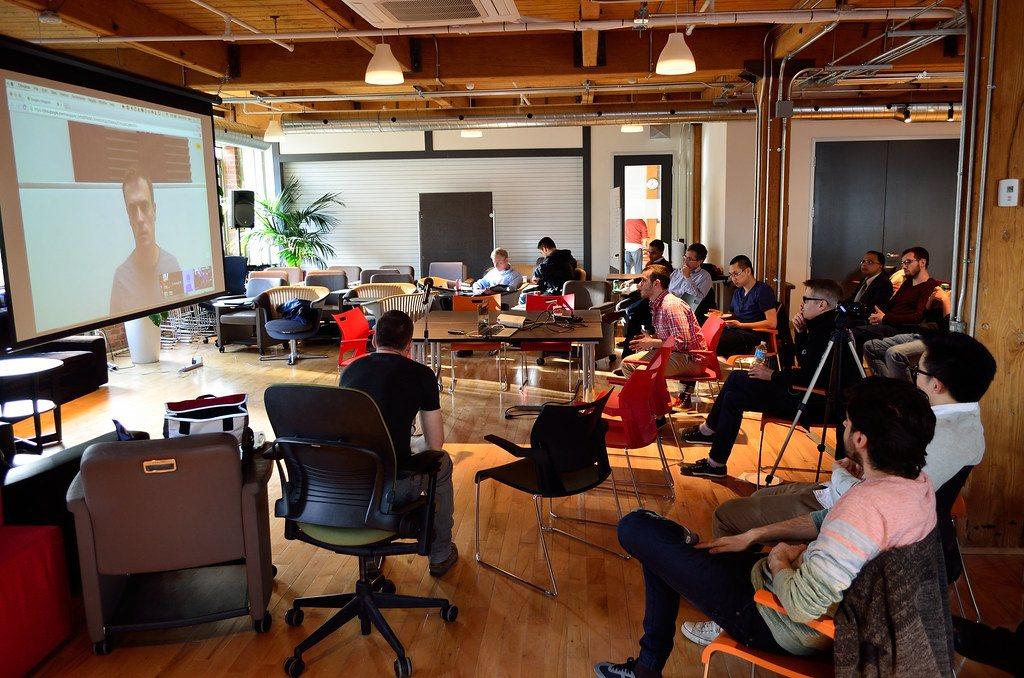
The best-known case came to light in 2024. A finance employee at the engineering firm Arup in Hong Kong joined a video call with what appeared to be the company's chief financial officer and other colleagues. All of them were deepfakes. Reassured by familiar faces and voices, the employee made 15 transfers totalling HK$200 million (about US$25.6 million) before the fraud was discovered.
The old tells, and why they are no longer enough
Early AI images were easy to catch. Some clues are still worth knowing, and the FBI lists several:
- Distorted hands, feet, teeth or jewellery
- Lighting, shadows or reflections that do not match the scene
- Lips that do not quite match the words, or sound that lags behind the video
- Jerky or unnaturally smooth movement, and faces that blur at the edges
- Garbled text on signs, labels or documents
- A voice with an odd tone, flat emotion or word choices the real person would not use
But the newest tools fix many of these mistakes, and a clip compressed for social media hides the rest. Finding no glitches does not prove something is real. The more reliable checks are about where content came from and who stands behind it.
How to tell what's real: six checks that work
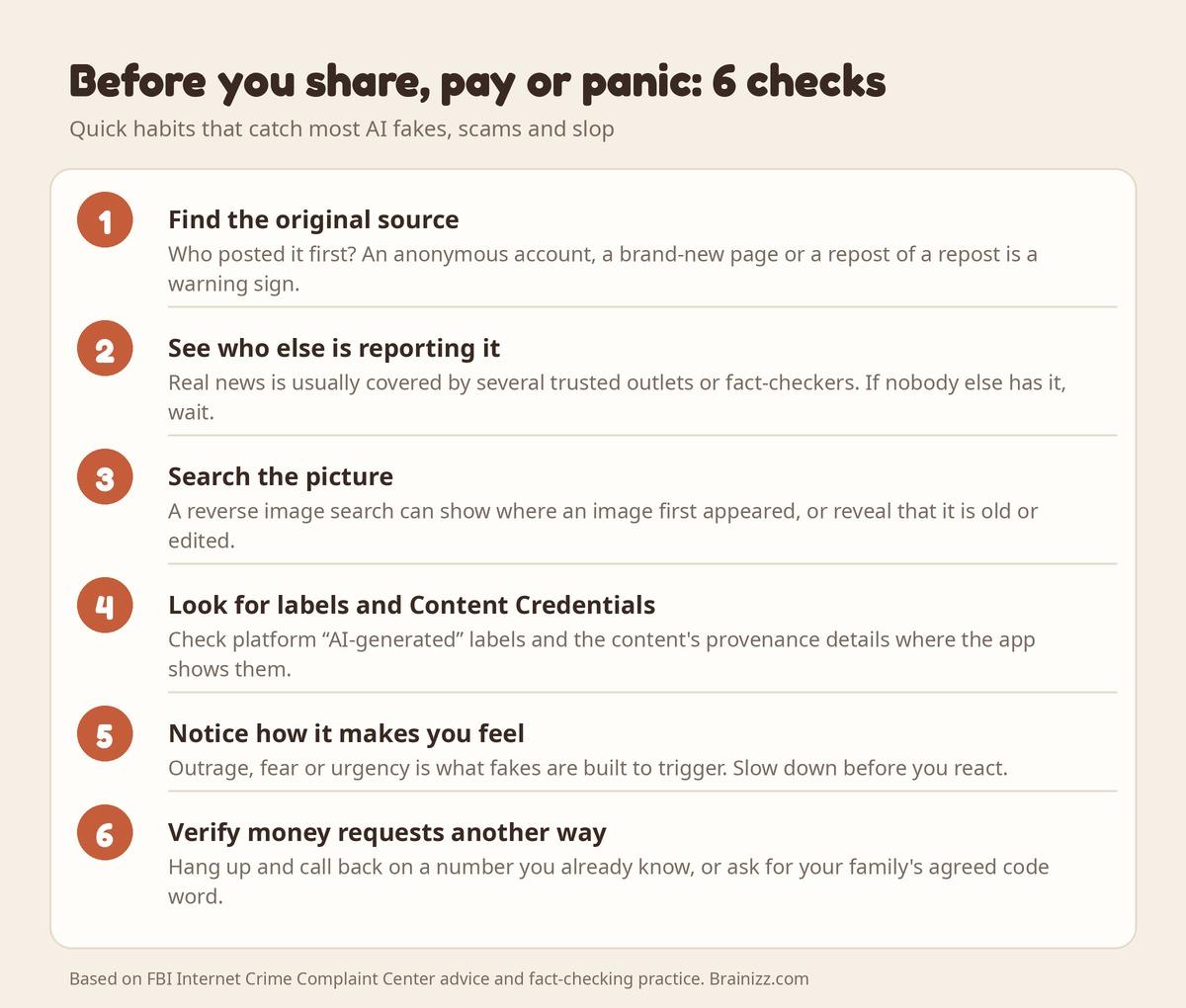
- Find the original source. Who posted it first? An anonymous account, a brand-new page or a repost of a repost is a warning sign.
- See who else is reporting it. Open a new tab and search for the claim. Real news is usually covered by several trusted outlets or fact-checkers; if nobody else has it, wait.
- Search the picture. A reverse image search can show where an image first appeared, or reveal that it is old, edited or from a different event.
- Look for labels and Content Credentials. Many platforms label AI-generated content, and some apps show provenance details that record how an image or video was made.
- Notice how it makes you feel. Outrage, fear and urgency are what fakes are built to trigger. Slow down before you share or react.
- Verify any request for money another way. Hang up and call back on a number you already know, and agree a secret code word with your family, as the FBI recommends.
Labels, watermarks and Content Credentials
Technology companies are adding ways to mark AI content at the source. Content Credentials, based on the open C2PA standard, attach a tamper-evident record to an image or video showing which camera or software made it and how it was edited. Invisible watermarks such as Google DeepMind's SynthID hide a signal in AI-generated images, video, audio and text that detection tools can read.
These are useful but not foolproof. Metadata can be lost when a file is screenshotted or re-uploaded, not every AI tool adds marks, and determined fakers can try to remove them. Treat a label as a helpful clue, and treat a missing label as no proof at all.
What the law says in 2026
Governments are starting to require transparency. In the European Union, the AI Act's transparency rules (Article 50) have applied since 2 August 2026: people who publish deepfakes must disclose that the content is artificial, chatbots must tell people they are talking to AI, and AI providers must mark generated content in a machine-readable way, with a grace period to 2 December 2026 for systems already on the market. A voluntary EU code of practice on marking and labelling AI content was published in June 2026.
In the United States, the TAKE IT DOWN Act, signed in May 2025, made it a federal crime to knowingly publish non-consensual intimate images, including AI-generated ones. Since 19 May 2026, online platforms must remove such images within 48 hours of a valid request, and the Federal Trade Commission has begun enforcing the law.
If you have been fooled or targeted
- Stop all contact and do not send more money, even if the scammer promises to return what you have lost.
- Contact your bank or payment provider straight away; acting quickly can sometimes stop a transfer.
- Report fraud to the police; in the US, report it to the FBI's Internet Crime Complaint Center at ic3.gov.
- Report fake accounts and content to the platform where you saw them.
- If intimate images of you are shared without consent, ask the platform to remove them; in the US, platforms must act within 48 hours and you can report those that do not to the FTC.
- Tell friends and family, so the same trick does not work on them.
The bottom line
AI has made it easy to fake almost anything, so seeing is no longer believing. The good news is that the most effective defence is not a special tool but a habit: pause, check the source, look for confirmation elsewhere and never move money because of a call or video alone. A few seconds of checking is usually all it takes.
Think you can spot the difference? Put your digital know-how to the test with the Brainizz quizzes linked below.